

Urban life, decoded
See the city through the eyes of its people. Discover how spaces are used, capture how people feel about places, and surface the issues they care about most.
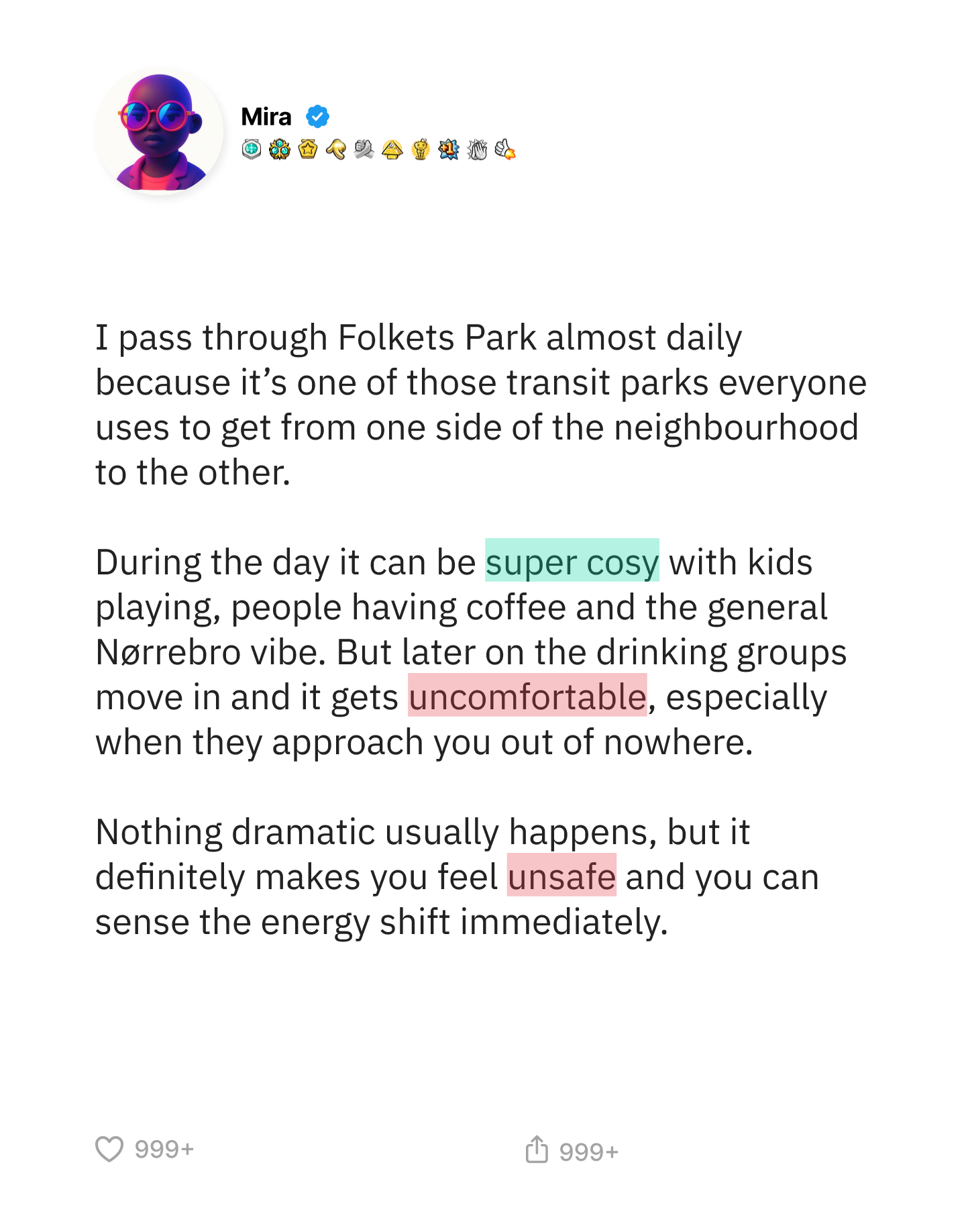
We analyze massive social data streams from 20+ sources to explain how cities behave






A window into lived experiences


City understanding, in minutes not weeks
Social Sensing at Scale
KONTEXT captures and interprets public conversations across 20+ online sources to reveal how people experience the city.

Multi-Lingual Engine
Your city's conversations come in more languages than anyone can handle. Our engine understands voices from all corners of the world, and while we don't speak C-3PO's six million languages (yet), we definitely try our best.
Real-time Sentiment Mapping
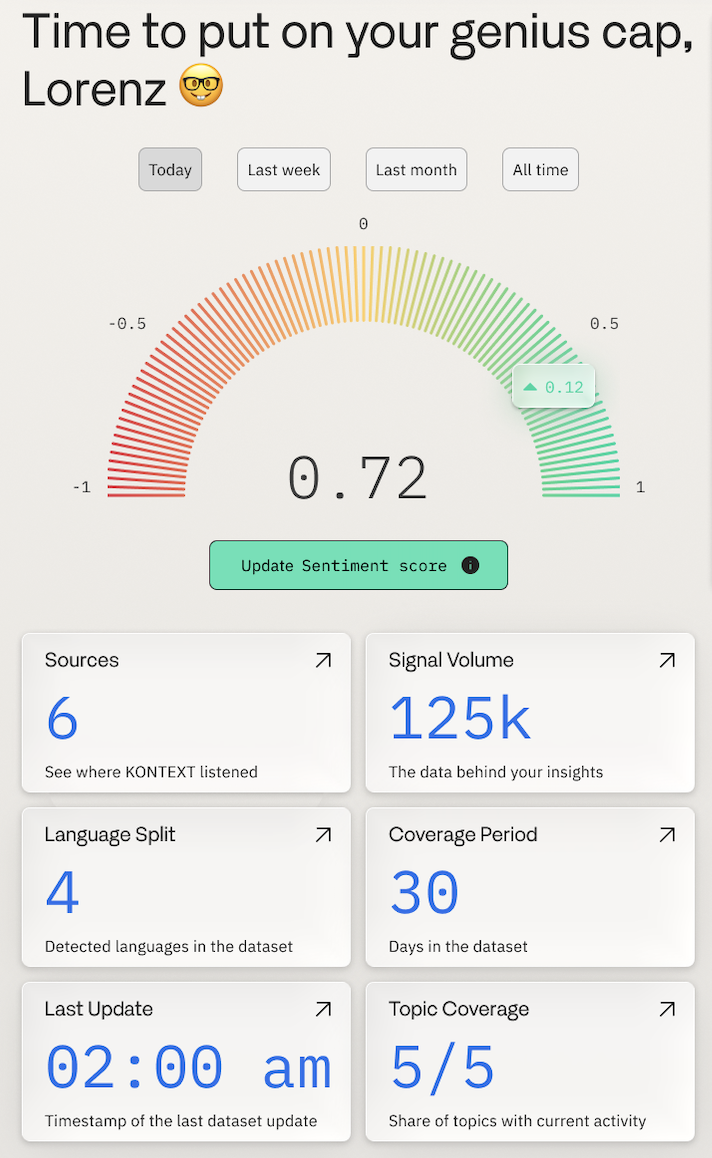
Keep an eye on how people feel across your city. Choose the topics that matter to you and spot what's trending upwards, what's falling behind, and what's beginning to emerge.
Insight Summaries & AI Chat
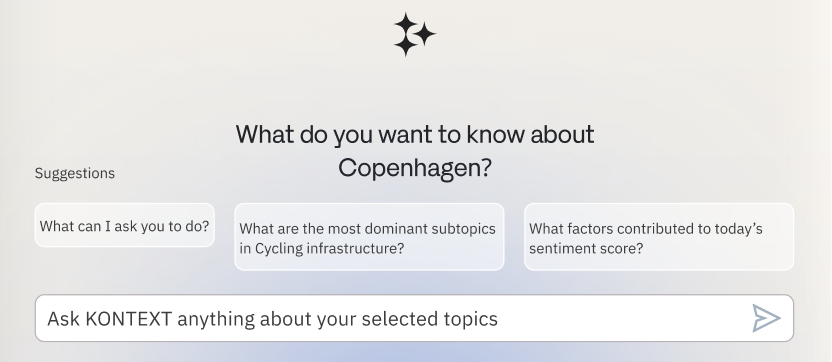
KONTEXT is like a bible for your team. It’s where the lived knowledge of your city comes together. Ask questions the way you'd ask a colleague and our engine gives you summaries shaped by real public conversations that reflect what people across your city are experiencing right now.
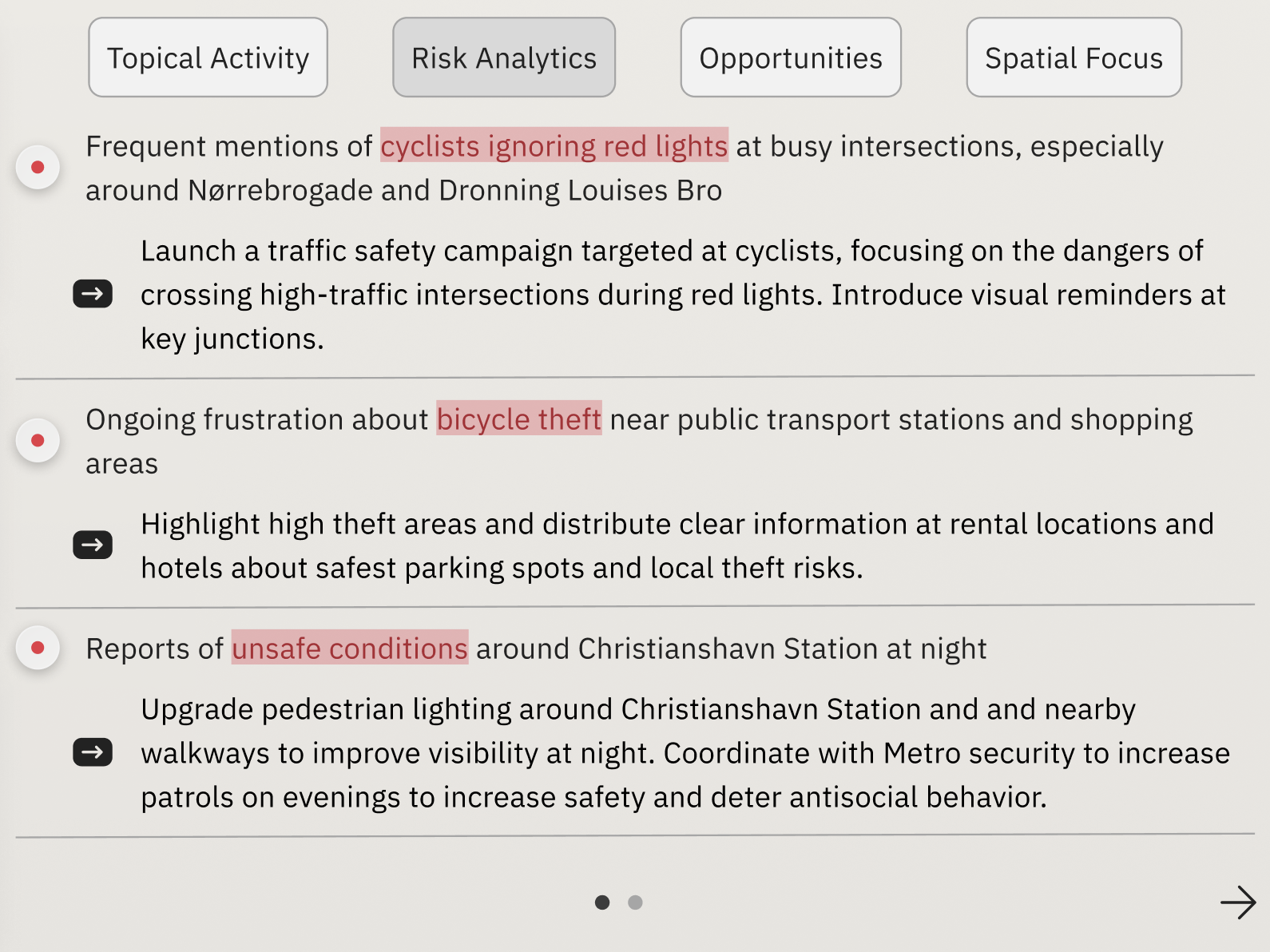
Automated Risk & Opportunity Detection
Surface early warnings, rising tensions and growing positive momentum so you can address risks early and build on what works.
, not a mind reader
Big decisions get shaky fast when you don't know how people truly experience the city. Our field notes capture a handful of the many stories where things went wrong simply because the lived reality was ignored.
Our system gathers lived experiences from across the digital world and turns them into insight that helps you see what is happening and understand why it is happening.

Why are customers gravitating toward certain locations and avoiding others?

What are visitors praising or complaining about?

What's frustrating people about moving through the city?

How do people experience the places we design in their day-to-day lives?

Why is demand rising in some areas and cooling off in others?

What are residents most concerned about right now?

How did people react to our latest event?
Why are customers gravitating toward certain locations and avoiding others?
What are visitors praising or complaining about?
What's frustrating people about moving through the city?
How do people experience the places we design in their day-to-day lives?
Why is demand rising in some areas and cooling off in others?
What are residents most concerned about right now?
How did people react to our latest event?
Why are customers gravitating toward certain locations and avoiding others?
What are visitors praising or complaining about?
What's frustrating people about moving through the city?
How do people experience the places we design in their day-to-day lives?
Why is demand rising in some areas and cooling off in others?
What are residents most concerned about right now?
How did people react to our latest event?
Kick things off in a few simple clicks. No onboarding needed.
We help you see the city the way people actually experience it
Just like no two people are the same, no two cities are alike. Time and again, projects fail because decision-makers did not understand the city from within. KONTEXT reveals how people actually experience the city, helping you see it through their eyes.
KONTEXT beats assumptions
Qualitative insight has long relied on formats that depend on presence and participation. Surveys, workshops, focus groups. But you don't like filling out surveys, we don't either, and most people simply run away.
KONTEXT takes a different path by tapping into conversations where they naturally happen, drawing insight from more than 20 sources including social and community platforms, news, blogs, review platforms, maps, and city data.







Current obsessions
Our field notes are an ever-growing collection from the metaphorical front lines. New case studies, projects, and collaborations as they take shape. As we pioneer the digital remastering of qualitative methods, we also share our reflections and hard-won lessons along the way.
This is a relatively new field, and so is our company. Our daily work is characterized more by experimentation than fixed routines. We learn by building, testing, and adjusting. Through our Field Notes, we open the conversation to others who are pushing the field forward.
If something here sparks a question or a nerdy counterpoint, don't be a stranger. Reach out. We studied Human Geography and Autonomous Systems. We are nerds. We walked away from steady paychecks to build KONTEXT. No funding, no start-up experience, no roadmap, just an unhealthy amount of curiosity and a lot of panic attacks that kept us going.
And yes, we live for discussions that are anything but boring.

Questions in, clarity out. That's us.
Below you’ll find answers to the questions we’re asked most often about KONTEXT. If you'd like to go deeper, our field notes collect case studies, perspectives, and stories that together reflect how our work unfolds in practice. And if something's still unclear, just talk to us.
What is KONTEXT?
KONTEXT is an AI-powered urban intelligence platform that helps you understand how people experience cities. It lets you see the city through the eyes of its people.
You can think of KONTEXT as a form of remote sensing for qualitative data. We call it social sensing. For decades, satellites have looked down on cities and measured what is happening through quantitative data like temperature, air quality, or traffic flows. That view is powerful, no doubt, but it stops at "what" is happening. It cannot explain the "why".
KONTEXT looks at the city from within. It focuses on qualitative data captured in language. Satellites are great, but they can't show why people are angry about a street redesign, or why they love Long Street and ignore Short Street. Those answers live in language, opinions, and everyday experiences.
Although we would love to take credit for being magical, and for turning all that qualitative data into something useful by saying something cool like “Aberto!”, the reality is a lot less glamorous. If you’re looking for magic, you’ll have to head to Hogwarts.
At KONTEXT, we work with more earthly tools. We know a thing or two about people and place, large language models, autonomous systems, sentiment analysis, and trend detection. What comes back from that work are clear, readable summaries of what currently bugs people in your city, surfaced as trends, emerging patterns, risks, and opportunities.
What kind of data does KONTEXT use?
KONTEXT works exclusively with information that people already share publicly and voluntarily. This includes public posts and comments on social platforms, online reviews, forum discussions, news articles, blogs, and public visual content such as image captions.
We do not access private data, personal messages, or paywalled content. Everything the system analyzes is part of the open digital layer of the city. When we speak of a "source", we simply refer to a platform or data feed KONTEXT listens to. This can include social platforms like Reddit or Bluesky, review sites, forums, and news or RSS feeds. Depending on your plan, KONTEXT listens to a different number of sources, typically 3, 6, or 10 or more.
Can I choose what topics KONTEXT tracks?
Yes. You have full control over what KONTEXT tracks and analyzes. When you get started, KONTEXT asks you to select your industry. Based on that choice, the platform suggests a set of topics that are commonly relevant for your field, but you can also enter your unique topic that is not covered by our suggestions. You can change, add, or remove topics at any time. As soon as you do, KONTEXT updates the analysis accordingly, so your insights always reflect your current focus. There is no need to set up a new project or start from scratch.
Who is KONTEXT for?
KONTEXT is built for people who make decisions about cities and places, and who need to understand how those places are actually experienced.
That includes people working in governments and municipalities, urban planning and architecture, transport and mobility, real estate and asset management, tourism and destination management, retail, hospitality, and events. It also includes less "obvious" professions such as journalists, who try to make sense of what is happening in cities and why.
What all of our clients have in common is not a specific job description or industry, but questions: How do people really feel about this place? What works, what doesn’t, and where are tensions or opportunities starting to form? And why?
What does ethical urban intelligence mean to us?
Lorenz, our founder, is a Human Geographer at heart and a Social scientist by training. That background comes with a habit of looking beyond immediate results and considering how systems affect people and society more broadly. For that reason, ethics at KONTEXT are not an afterthought. They have shaped how we design, build, and operate the platform from the very beginning. We apply the same rigor to ethical questions as we do to technical architecture.
Our approach is grounded in four foundational principles. The system is subject to continuous audit. Accountable human oversight is always required. We work exclusively with publicly available data and do not rely on unethical or illegal data scraping practices. And we focus on aggregated patterns rather than individuals, automatically removing personal identifiers along the way.
Our goal is insight into places, not monitoring of people. This distinction matters.
What makes KONTEXT different from traditional qualitative data collection methods?
Since you’re exploring KONTEXT, we’ll skip the basics of why qualitative insight matters for good decision-making. We’ll assume that part is already clear.The conversations happening online describe how places and spaces are actually experienced, without prompts, filters, or participation barriers. Compared to traditional methods, combining qualitative insight with computational data analysis techniques allows us to work faster, at greater scale, and with broader representation, using significantly fewer resources.
Traditional qualitative methods such as surveys, interviews, workshops, and focus groups are valuable (and we do not attempt to replace them but rather to complement them), but they come with clear limits. They take time to organize, are expensive to run at scale, and usually capture feedback from a small and often unrepresentative group. By the time results are compiled, they often reflect the a snapshot from the past rather than what is happening now. Because KONTEXT analyzes massive social data stream continuously and at scale, it provides a live, place-based picture of sentiment, patterns, risks, and opportunities across cities and neighborhoods. Insights update as conversations change, making them more timely and more representative than one-off studies.